LOOP ARCADE Product and business plan
LOOP ARCADE is one mobile game with an expanding collection of mini-games. Shared rewards and progression connect them. We begin with two games, then plan to add more through updates guided by player evidence.
- Product
- One mobile game, expanding mini-games
- Initial scope
- Two games and shared progression
- Release status
- In development
The product thesis
A good short game can earn another round. LOOP ARCADE's hypothesis is that connecting mini-games through rewards, unlocks and saved progression can also give players a reason to try another game and return later. New games join the same product rather than restarting the collection.
We are designing for casual mobile players who enjoy quick timing challenges and small logic puzzles. The first collection will serve this specific audience before adding more genres.
What we want to solve
- Make the first round understandable without a long tutorial.
- Let progress matter after a round ends, while keeping skill-based play meaningful.
- Give the next game a place in an existing collection instead of asking players to start again.
Project team
The project team comprises four contributors: one designer, two developers and one planner.
| Role and contributors | Area of work |
|---|---|
| Design · 1 | Game art and interface design. |
| Development · 2 | Unity game implementation and shared systems. |
| Planning · 1 | Game rules, progression and content planning. |
Pixel-art direction
We use AI to explore pixel-art concepts around the rainy city and yellow raincoat of LAST GRIP, and the warm kitchen and two robots of ONE BEAT KITCHEN. The team compares the concepts and refines the chosen direction, checking character and color consistency.
Unity development
We recently connected Claude and Unity through MCP to bring code changes, testing and build checks into one workflow. We review test results and check behavior in the build as we iterate on the prototypes.
We plan to broaden AI support to repeated testing and error analysis, and integrate it more deeply into production. The team will continue to review the final art and play experience.
One game, an expanding collection

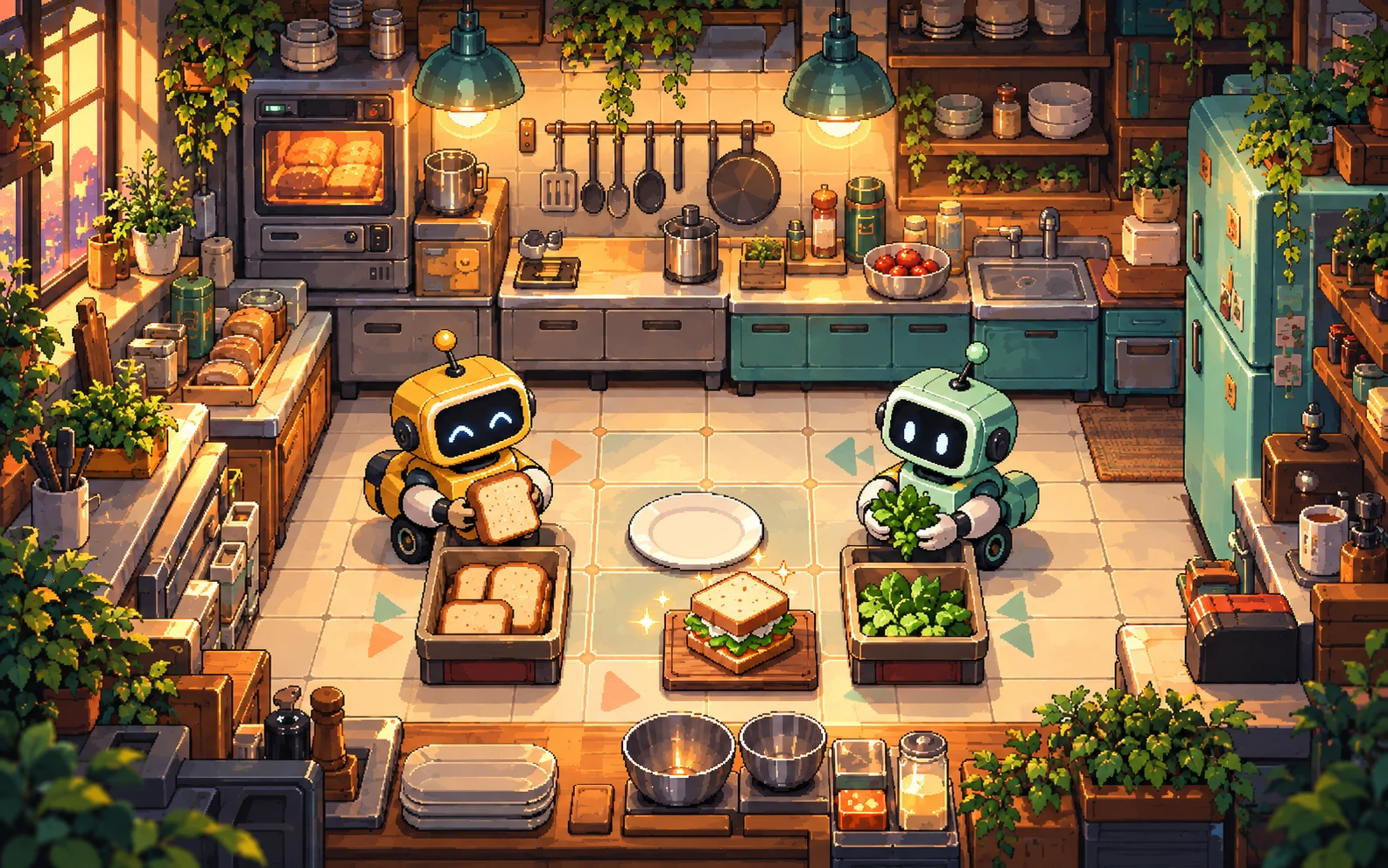
The proposed shared layer includes earnable Loop Points, cosmetics, an inventory and permanent upgrades. Rewards earned in LAST GRIP can contribute to collection unlocks and preparation for ONE BEAT KITCHEN; rewards from the next game feed back into the same progression. Each mini-game must also be enjoyable on its own.
Ongoing game additions
The first two games establish the shared system. Future mini-games will be added within LOOP ARCADE through updates, with common reward events, inventory and save rules. We will test which items and upgrades apply across games, how rewards stay balanced and whether new content brings players back.
| Design choice | Expected benefit | What must be tested |
|---|---|---|
| Different game mechanics | Offer variety within one app. | Do players willingly try the second game? |
| Shared earnable points | Carry rewards across the collection. | Are point earnings fair across games of different difficulty? |
| Persistent collection | Give repeat play a visible purpose. | Does progression support retention without excessive grind? |
Development began around October 2025 and is ongoing in Unity. Current work includes game concepts, prototype development and a defined art direction. Mobile integration, the shared economy and release testing remain to be completed. The artwork is illustrative, not a capture of a released app.
Business model
We plan to test free access with optional cosmetic purchases and opt-in rewarded ads. These are proposed models, not implemented revenue streams. The first test is whether players return for the games themselves.
| Model to test | Player value | Decision criterion |
|---|---|---|
| Cosmetics | Personalize the collection without buying competitive advantage. | Measure willingness to pay, repeat purchase and support burden. |
| Rewarded ads | Offer a clearly described, optional reward. | Compare revenue with effects on retention, session quality and complaints. |
| Content expansion | Add new ways to use an existing collection. | Compare development cost with use of new games and incremental retention. |
Loop Points are intended as in-game progression rewards, with no proposed cash redemption. Pricing, ad placement and purchase limits will be decided after testing and platform review.
Development milestones
We use completion criteria to decide when to move forward. Calendar dates will be set against the actual build scope, available resources and test results.
Define the coreCompleted
Refine the two game rules, readable feedback, controls and visual identity. Keep the scope small enough to compare design decisions with playable prototypes.
Exit criterion: Players can understand each game and finish a first round without developer guidance.Build the mobile MVPIn progress
Integrate two playable games, a shared Loop Points balance, inventory and saved progression. Add a testable event model for rewards and upgrades.
Exit criterion: Progress survives restart; duplicate rewards, save failures and economy exploits are tested on target devices.Run a closed player testIn progress
Recruit a defined test cohort. Observe onboarding, return visits, cross-game play and qualitative feedback before adding more games.
Exit criterion: A cohort report identifies what retains players, where they leave and which changes improve the next test.Release in a limited scopePlanned
Choose an initial platform and launch market after the closed test. Test monetization, support and content updates before wider distribution.
Exit criterion: Retention and net revenue evidence support the cost of acquiring and serving players; stability and support are ready.Add and connect new mini-gamesPlanned
Add new mini-games through updates to the same mobile product. Reuse common reward and save rules, test item compatibility and rebalance the shared economy as the collection grows.
Exit criterion: Each addition preserves existing progression, offers a distinct reason to play and shows cross-game usage that justifies its production and support cost.
What we will measure
A useful investment case needs player evidence. Our planned measurement framework separates product engagement, system reliability and commercial viability. No measured cohorts or revenue results are presented here.
| Question | Measure | How it changes the plan |
|---|---|---|
| Do players understand it? | Tutorial completion, first-round completion, time to first reward. | Revise controls and onboarding before adding content. |
| Do they return? | Day-1 and day-7 retention, repeat sessions, player interviews. | Compare each cohort and prioritize the loop that explains return play. |
| Does the collection work? | Second-game adoption, point use, progression distribution. | Rebalance rewards and check whether the shared layer adds value. |
| Can it sustain a business? | Net revenue per player, acquisition cost, refunds, support and content cost. | Expand acquisition only when cohort evidence supports the spend. |
| Is it reliable? | Crash-free sessions, save recovery and reward consistency. | Resolve critical failures before release or paid acquisition. |
Target thresholds will be set before each test, with a stated cohort size and observation window. Small samples will be reported as exploratory results, not treated as proof of product-market fit.
Initial go-to-market
Start with the games, not a broad acquisition campaign. Short gameplay clips and a focused mobile test should tell us whether the mechanic is understandable and worth another round.
- Prepare actual gameplay clips that show the action, failure and retry loop. Keep concept art clearly labeled.
- Recruit small cohorts from communities relevant to timing games and logic puzzles; track where testers came from.
- Choose the first platform and market based on device coverage, support capacity and test feedback. Localize additional markets after the core loop is stable.
- Consider publishing partnerships for distribution, live operations or market expertise when responsibilities and economics are clear.
Capital priorities
The funding plan should support the next verifiable milestone: a mobile MVP and a credible player test. This page sets spending priorities; the raise amount, valuation and detailed runway budget have not been published.
| Priority | Work funded | Evidence produced |
|---|---|---|
| Core development | Mobile integration, shared economy, inventory and save integrity. | A testable MVP with complete progression flows. |
| Art and usability | Production assets, readable feedback, sound and touch-control refinement. | A consistent, understandable first-play experience. |
| Testing and measurement | Device QA, cohort recruitment, instrumentation and analysis. | Retention, reliability and cross-game usage reports. |
| Controlled launch | Store preparation, localization, support and small acquisition tests. | A costed launch process and early commercial evidence. |
A detailed financing discussion requires a scoped development budget, individual responsibilities, company documentation and a milestone-based cash plan. These should be reviewed directly with the studio.
Risks and decisions
| Risk | Response | Decision trigger |
|---|---|---|
| Shared progression adds little value | Compare use of a single game with cross-game play, using matched cohorts where practical. | If the shared layer does not improve repeat play, simplify it. |
| Uneven rewards or excessive grind | Test earnings by skill and play time; cap exploitable reward loops. | Rebalance before increasing the game catalog. |
| Production scope grows too fast | Finish two games and reusable shared systems first. | New worlds require a scoped cost and evidence of player demand. |
| Monetization weakens the game | Test optional models and monitor retention and complaints alongside revenue. | Remove or revise placements that harm long-term play. |
| AI-assisted production quality | Review asset consistency, provenance, licenses and game behavior before release. | Ship only reviewed assets and tested functionality. |
Investment and publishing inquiries
For a discussion about development, publishing or investment, contact the studio. We can align the discussion around the current build scope and the next validation milestone.
hello@pomorune.comThis is a development-stage working plan. Strategies and milestones may change with test results and resources. Market size, user traction, revenue, fundraising terms and corporate status are not asserted on this page.